Geiger Counter Explorations
Tue, 13 Jan 2026 12:00:00 -0700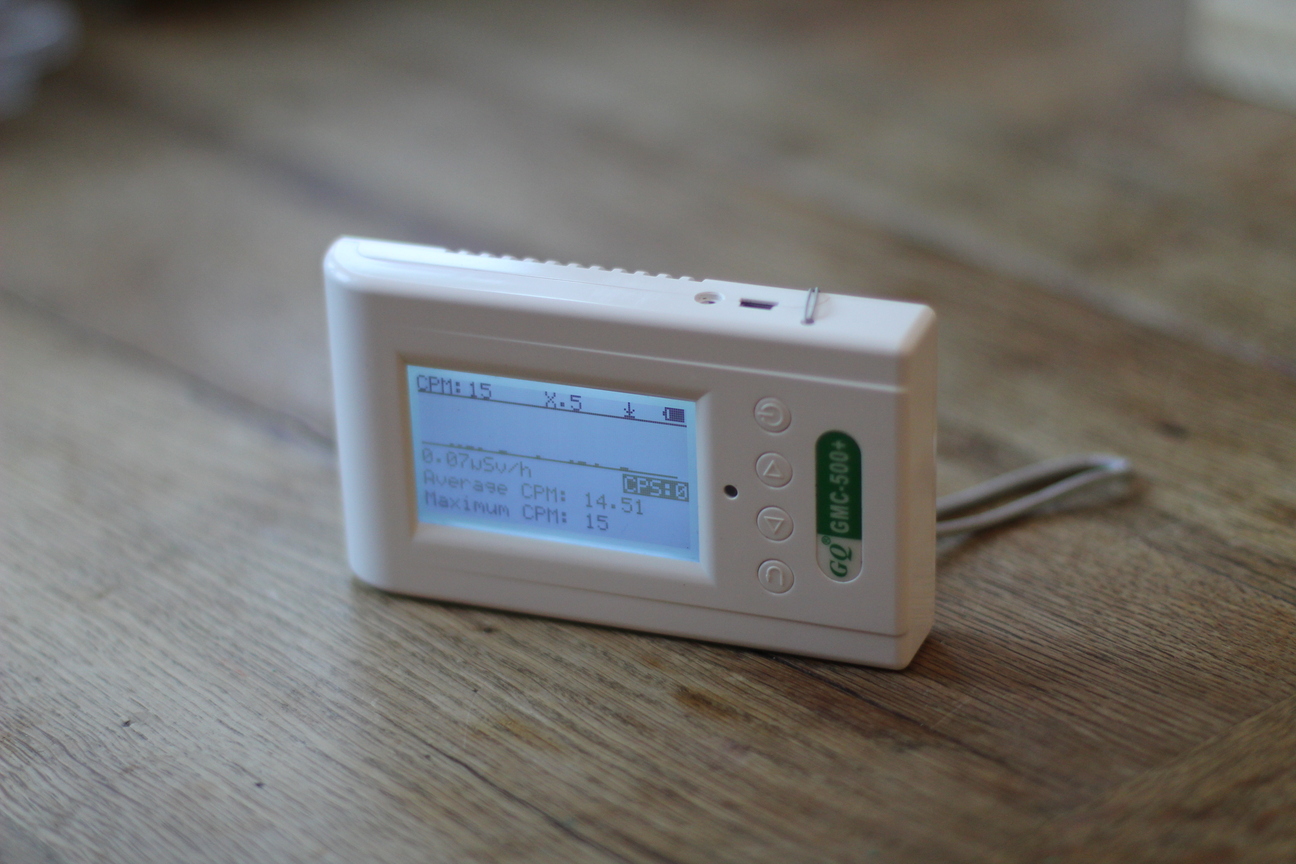
The GQ GMC-500+ Geiger counter.
I am a difficult person to choose gifts for, but weird sensors is one category that I openly accept. This is the story of how I was gifted a Geiger counter one Christmas and what things it led me to find in my day-to-day life.
A word on ionizing radiation in the human environment
I want to begin by acknowledging that ionizing radiation, by both being known to be harmful and yet invisible and and undetectable to our human senses, is a source of anxiety for many people. I want to personally assure you that in two years of owning a Geiger counter and sticking it in many different places, I have not found anything in the human environment around me that is radioactive enough to cause harm. Small amounts of naturally-occurring ionizing radiation are always coming from the ground underneath us, from the air around us, and from within us and other living beings. This "background radiation" is vastly too small to cause us harm, but it can be measured and used to explore a new side of our everyday world and uncover some benign surprises. For more discussion and more thorough analyses with fancier gear, I refer you to the excellent Radioactive Drew on YouTube.
The Geiger counter
My Geiger counter is a GQ GMC-500+. It has a pair of Geiger-Müller tubes and each time a gamma ray passes through its electrically charged vacuum interior and makes a splash of electrons, its green LED lights up and the speaker makes a click. The plastic enclosure and the nature of Geiger-Müller tubes mean that it isn't particularly useful for detecting alpha or beta radiation, which can only travel extremely short distances through matter before being absorbed, but other consumer-grade portable detectors exist which do detect those.
The GMC-500+ is also quite hacker-friendly. It features a USB mini-B port (the one shaped like Pizza Hut) where you can talk to the device over a serial port using a thoroughly-documented protocol, and extract historical measurements from its on-board memory. It can connect to wi-fi and regularly send measurements over HTTP to a custom endpoint with a simple query string, for example to the real-time radiation world map maintained by the manufacturer.
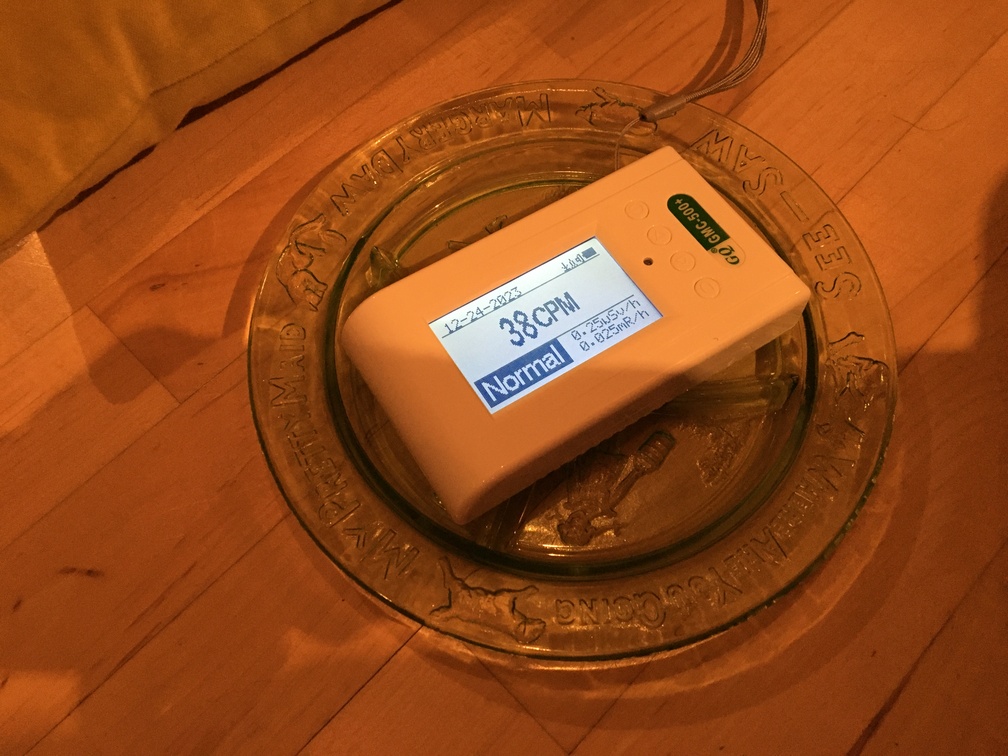
My first moment with the Geiger counter. Background radiation was around 20 counts per minute (CPM) but this piece of vintage uranium glassware from the back of the cupboard was around twice that.
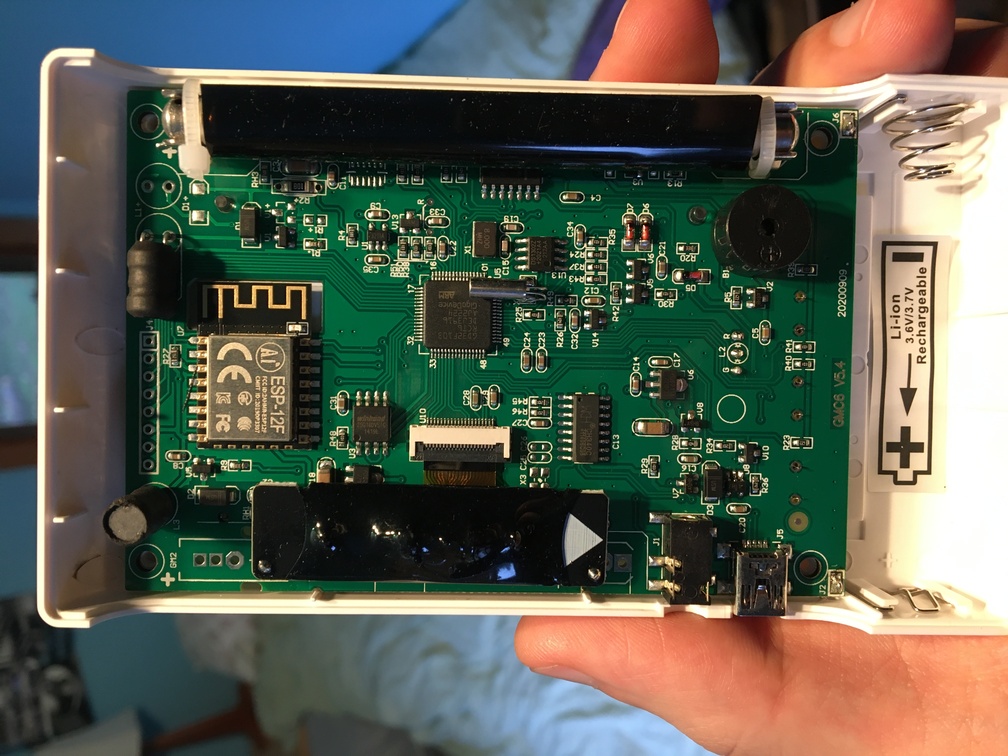
The interior of the Geiger counter, because I couldn't help myself and just needed to look inside. The lithium battery was included, I just took it out for safety. The two Geiger-Müller tubes are at the very left and very right, encased in black. One provides sensitive measurements during normal conditions but has an upper limit to the number of events it can measure in a given time span. The other tube is less sensitive, and so saturates less readily and can continue distinguishing radiation levels when the first tube is max-ed out. Thus the two are combined for higher dynamic range.
Initial findings
During the first several weeks of having the Geiger counter, I found ... a whole lot of nothing. I took it on a road trip. To parties. Around the city. I waved it slowly around weird machines and over low crevices in suspicious-looking alleyways. Each time two or even three clicks would sound in rapid succession I felt a little jolt of excitement, but each such moment was followed by silence, regardless of what I placed it near. The only measurably radioactive things I found during this time were a plate of greenish uranium glass at a family member's house, plus some similar dishes at an antiques shop, but those gave off merely twice the level of background radiation right at the surface.
Ionizing smoke detectors
They're falling out of favour, but ionizing smoke detectors are still around in many homes. These work roughly by exposing a small chamber of ambient air to a tiny spec of radioactive americium and then seeing whether there was a change in electrical activity from smoke particles being ionized and gaining a charge. The americium source inside isn't a gamma emitter, but the unstable daughter elements that it decays into are, and so some activity can be measured with the Geiger counter.
After trying two other used smoke detectors and learning that they were the newer kind with an electrochemical sensor and thus not radioactive, I found one in a pile of free stuff on a roadside table while cycling one night and took it with me.
Safety notice
It's objectively stupid to take apart an ionizing smoke detector. But when it comes to having a tiny spec of radioactive americium exposed to the open air in my house, that's actually nothing new because that's exactly how these smoke detectors operate for their entire lifetime. With the Geiger counter, I was able to measure the emitted radiation at every step and confirm that throughout, it really was the tiny dot of material at the center of the inner metal enclosure that was doing anything, and that nothing was being spread.
The only real risk I could think of here was the chance that the small americium source might get damaged and spread around, or that it might inadvertently spend a lot of time right next to a person. For this reason, I was very careful to never touch the recessed center of the radiation source directly, not even with any tools. The americium is welded on and so you'd need to physically scratch it to remove any radioactive material.
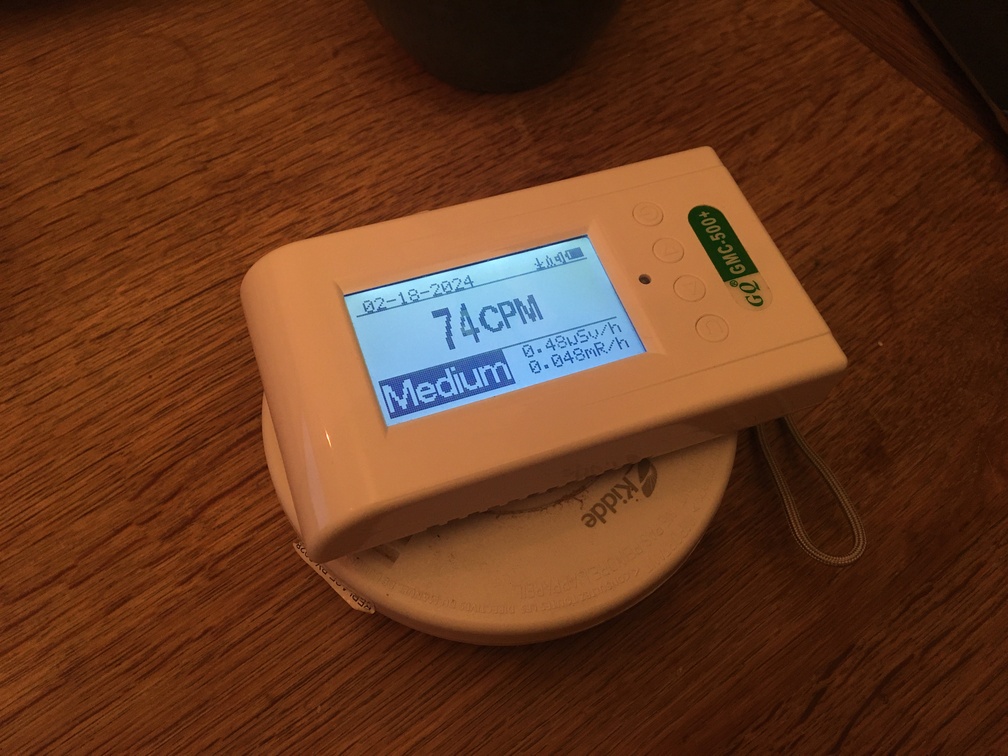
The Geiger counter measuring about 4x background right against the outer enclosure of the unopened ionizing smoke detector.
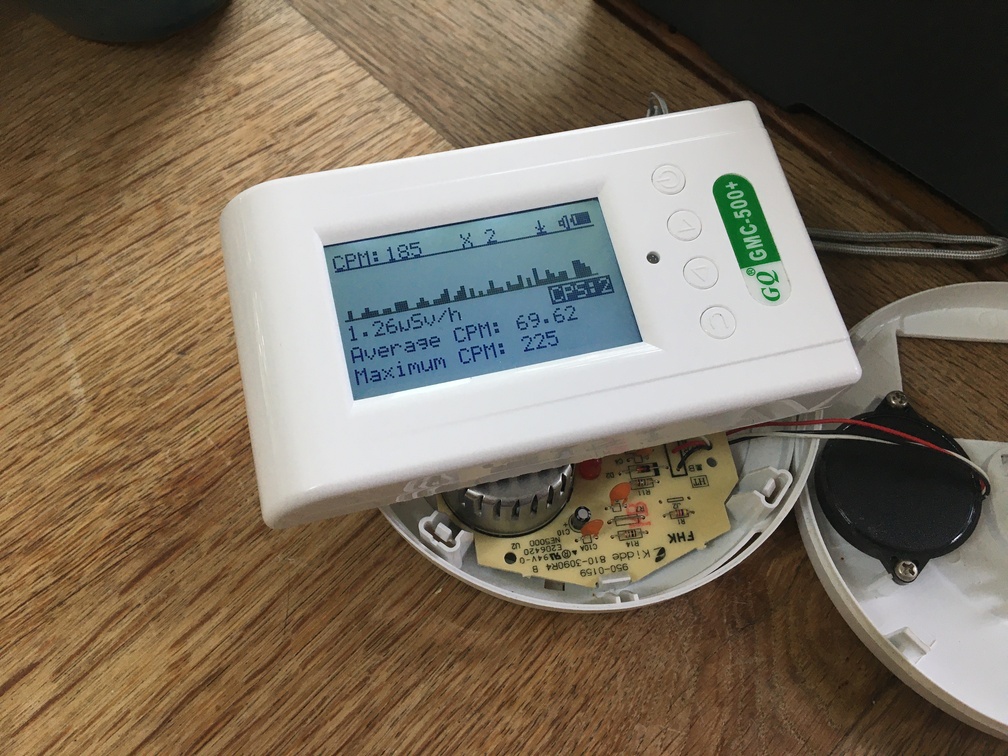
Radiation levels were about 10x background against the outside of the (open, vented) metal enclosure.
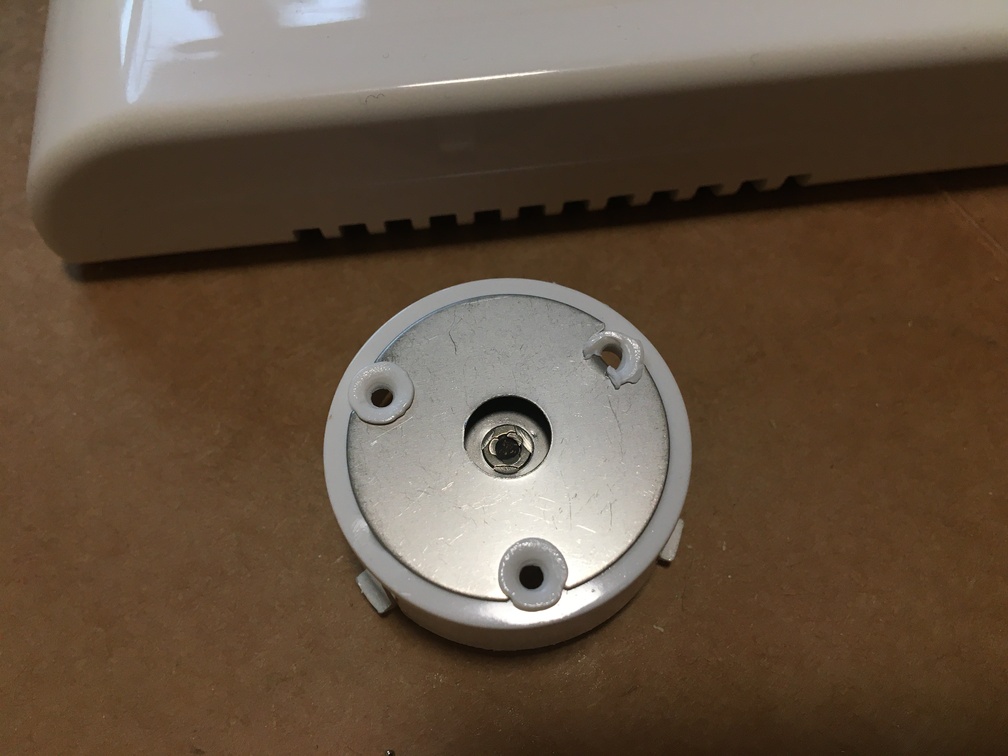
The bare americium source, which is the tiny dark spec at the center of the recess. Fortunately, the surrounding steel provides reasonable protection against accidental contact. I made no attempts to disassemble the radiation source further because that would be ACTUALLY stupid.
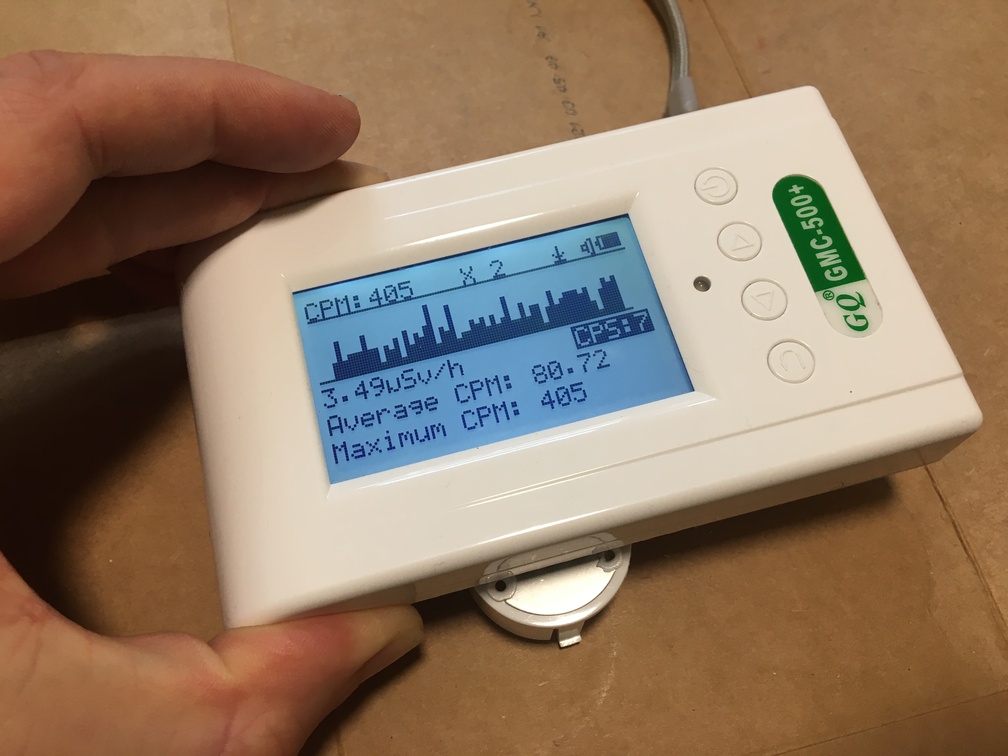
At close range, the Geiger counter measured about 20x background radiation level. Judging by the onscreen microSievert dosimeter, we can estimate that holding this up to your face for an hour would give about the same radiation dose as a couple dental X-rays. I did not try this.
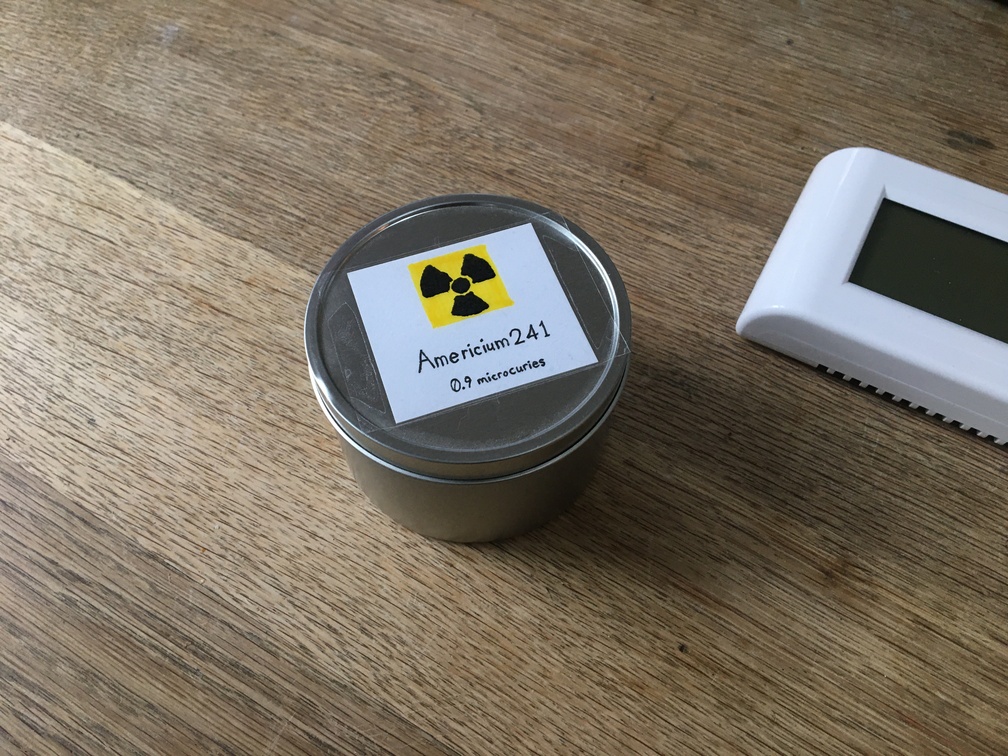
For safekeeping (and fun), I built an enclosure out of a steel tin and foam padding in which to store the radiation source. Distance alone provides a fair bit of protection from such a tiny source, in addition to the steel, and I was unable to measure anything above background on the outside of the tin.
Antique Fiestaware
Uranium is useful for many things, including making beautiful colours. Prior to World War II, Fiesta and other ceramics manufacturers used uranium oxide glaze for the deep blood-orange red it produces, including in mugs, bowls, and other kitchenware. Then the US government stole Fiesta's uranium to make a bomb, and red pottery glaze hasn't quite been made the same since.
Many Fiestaware dishes live on in antique shops. I actually failed at first to find any myself. I was walking around a local antiques shop rather conspicuously with my Geiger counter in hand when the clerk noticed and beckoned me to the shelf behind the counter.
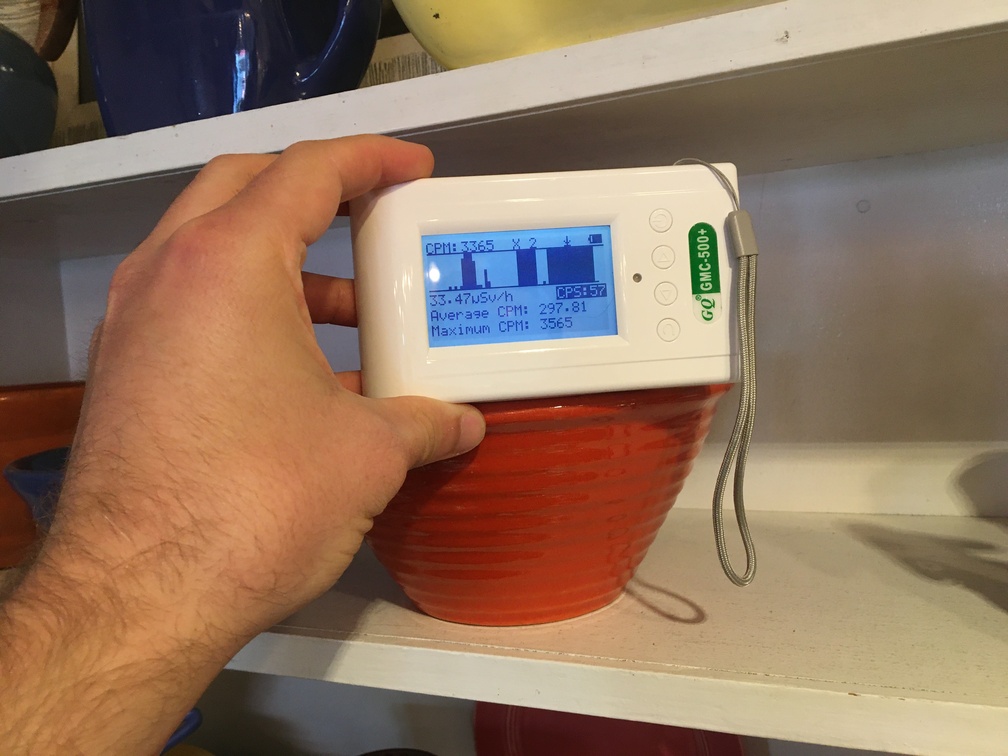
Oooh that's hot! This bowl was about 200x background radiation at close range, over the entire surface.
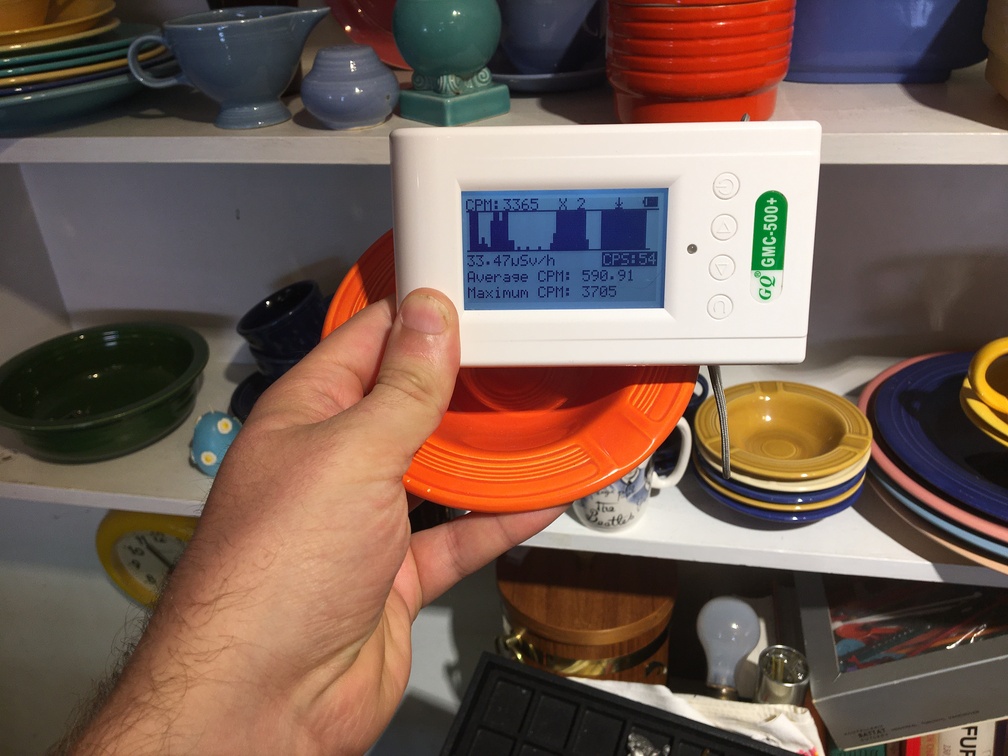
It's only the reddish orange dishes that are measurably radioactive, other colours use different pigments that aren't radioactive. The ceramic glaze keeps the uranium contained which is why I don't mind holding this in my hand. But I have no desire to eat off of this or keep it in my house, especially not at the suggested price.
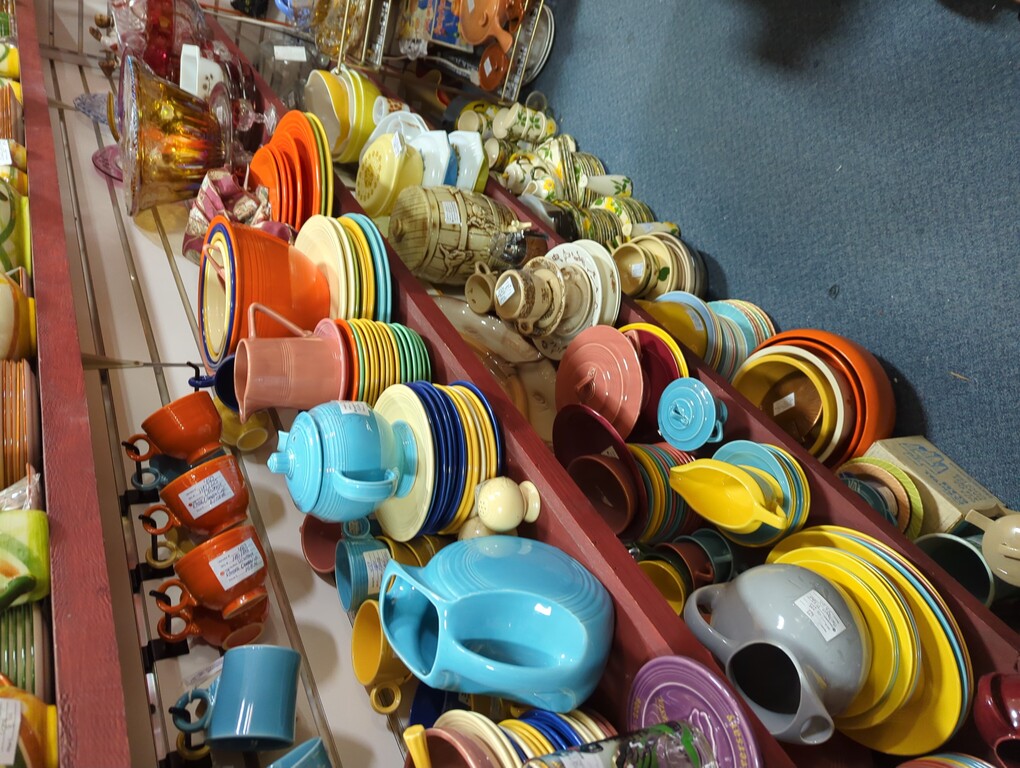
Much later, I would find a large amount of Fiestaware at the Brass Armadillo Antique Mall in Denver, Colorado. Curiously, the eery green clearly-labeled uranium glassware fluorescing under ultraviolet light was MUCH less radioactive than the heaps of Fiestaware.
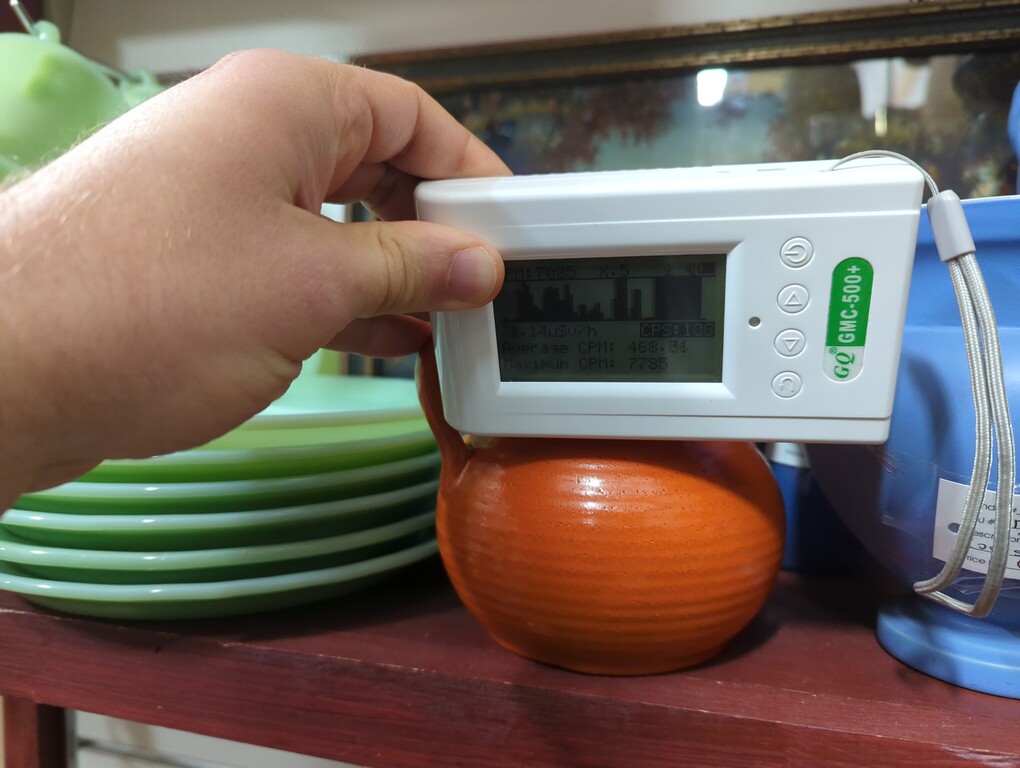
Hot stuff!! 400x background on the surface of this vase.
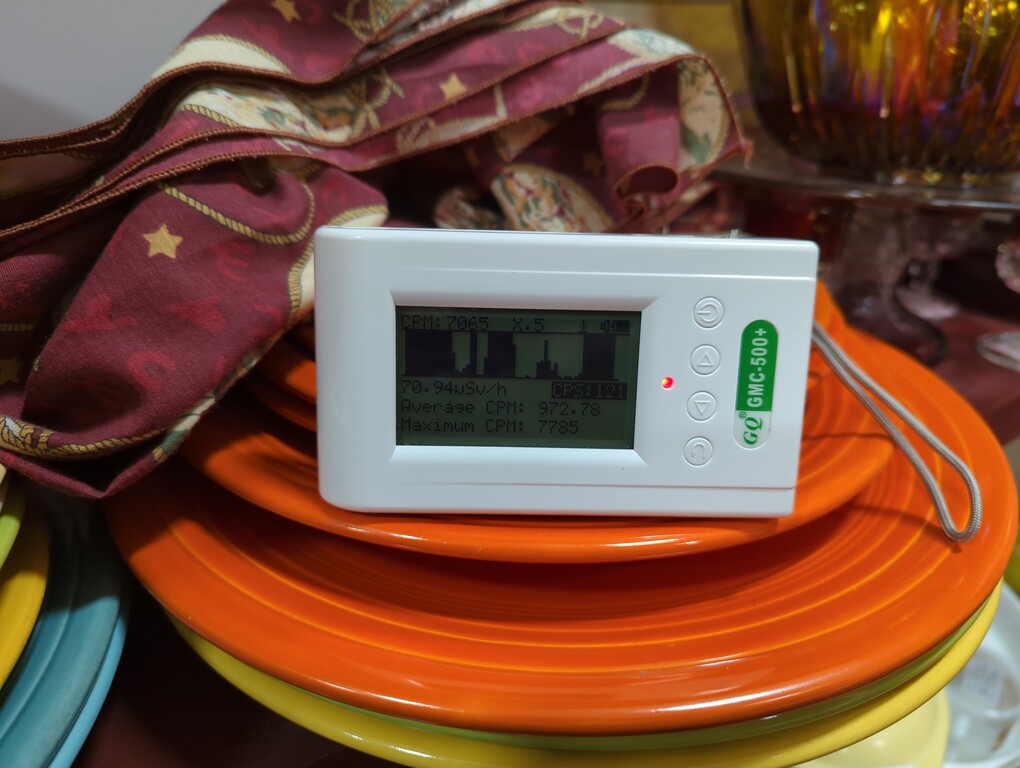
Spicy!
Mildly concerning.
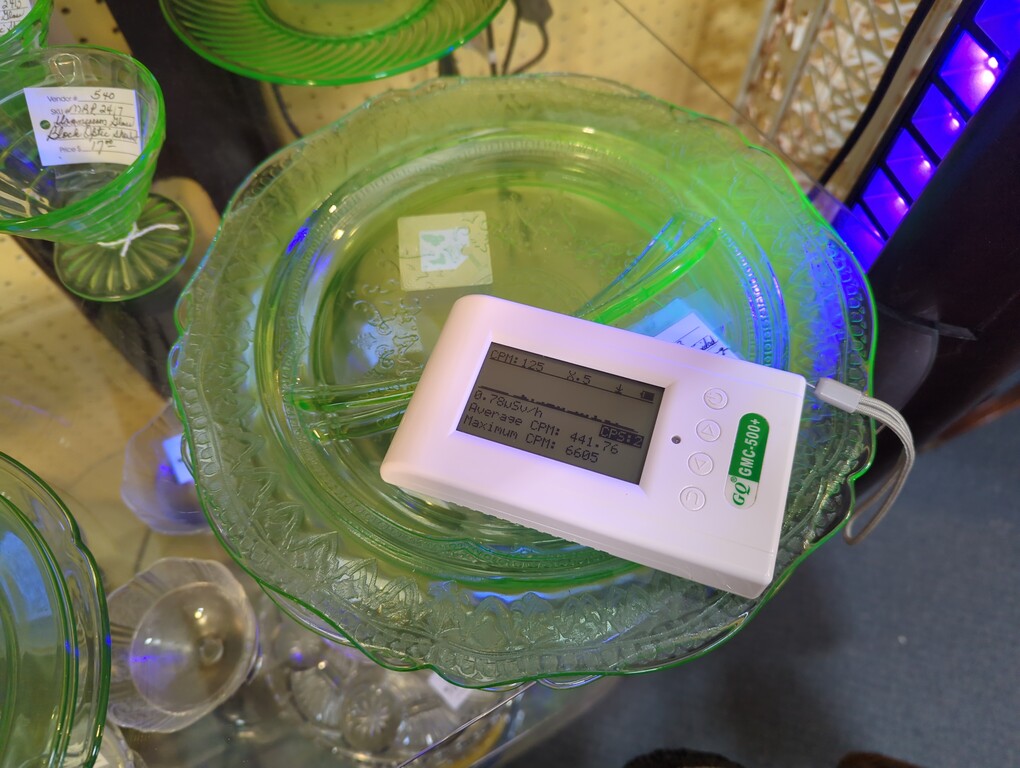
Spooky green uranium glass, UV illumination for dramatic effect, and yet merely 6x background radiation.
Reading stored radiation measurements over the serial port
The GMC-500+ provides a serial port over USB and the protocol is reasonably well documented, supporting a set of queries to get information about the hardware and its measurements. After a false start attempting to write my own Python library to wrap this, I found Chaim Zax's gq-gmc-control on GitHub and was quickly able to offload and plot saved measurements from the internal memory of the GMC-500+.
Here's a quick calibration plot I did with the americium source from the smoke detector.
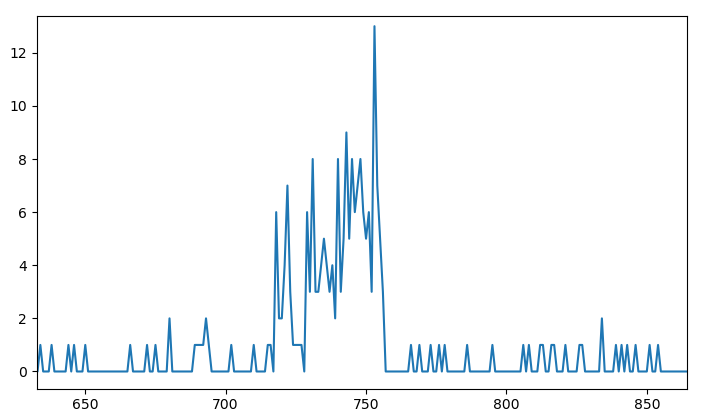
A graph of counts per second versus time as I waved the Geiger counter over the americium source for a few seconds.
But I didn't go to this effort just to visualize things from the last 30 seconds, which the Geiger counter can already show on-screen. I wanted to plot bigger things.
Airport luggage scanners
It was when I was preparing to board an overseas flight to Germany that I learned that the GMC-500+ readily detects X-rays. I kept it powered on inside my backpack while getting my carry-on luggage scanned by airport security. Later, I was waiting for food near the gate and decided to check the Geiger counter. The current radiation level was fine, but the estimated maximum counts per minute was at a quarter of a million.
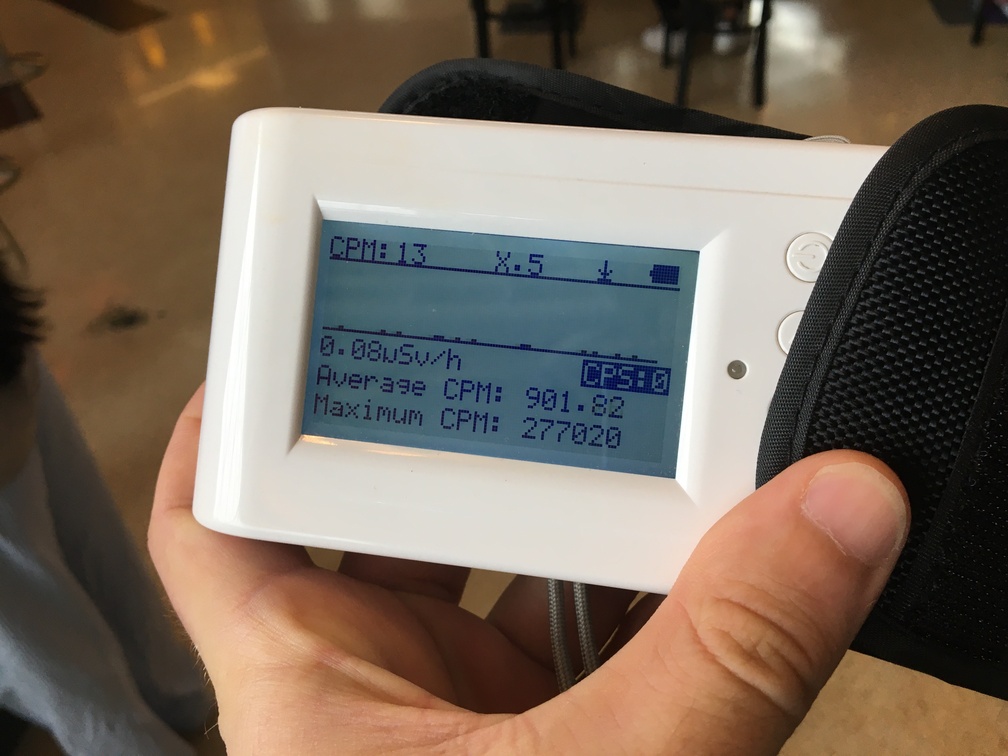
Maximum estimated CPM is 277020 and the average is still falling slowly back down as I wait for my veggie burger.
This average value is a bit misleading. In reality, the CPM wasn't computed by counting for an entire minute, but rather projected from a much shorter time span. This time span can be changed in the device's settings and I prefer it short for interactivity.
A plot of the actual second-by-second data recorded on the device tells the real story.
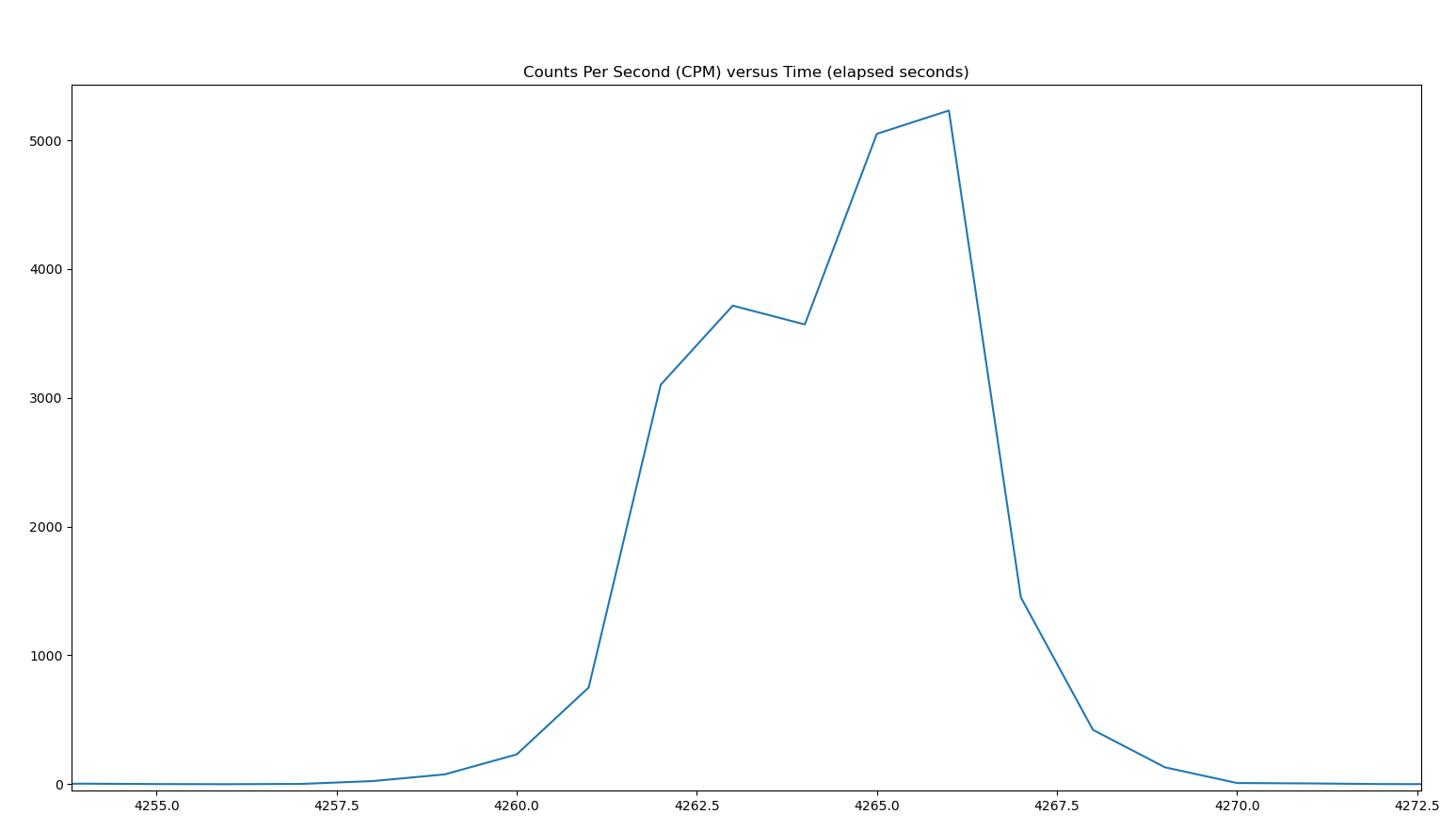
Counts per second (CPS, pardon my typo) as the Geiger counter passed through a luggage scanner. 5000 counts per second! What a toasty little oven.
I'm glad that this Geiger counter can be made silent. It avoids questions.
Other carry-on luggage scanners at other airports behaved similarly, hitting my stuff with between 3000 and 5000 counts per second of X-rays for a few seconds. While it would make an interesting comparison, I never put the Geiger counter into checked-in luggage because it contains a lithium battery, which is banned there.
Passenger airliners at cruising altitude
Outer space is very radioactive, and because earth is in outer space, it gets hit with a lot of radiation. Most of that radiation gets absorbed by the atmosphere before it can reach the ground. But the higher up you go, the less air there is to bump into and slow you down, and so that's where cosmic rays and commercial jet planes meet.
It was at this point that I learned, in some ways, a Geiger counter is also an altimeter!
After takeoff, I watched the radiation level gradually climb as the airplane gained altitude until just under 8 km, where the radiation remained steady at about 15x background level.
When plotted over the duration of the flight, you can actually see the asymmetry between the aggressive climb to cruising altitude after take-off and the more gradual glide down in preparation for landing.
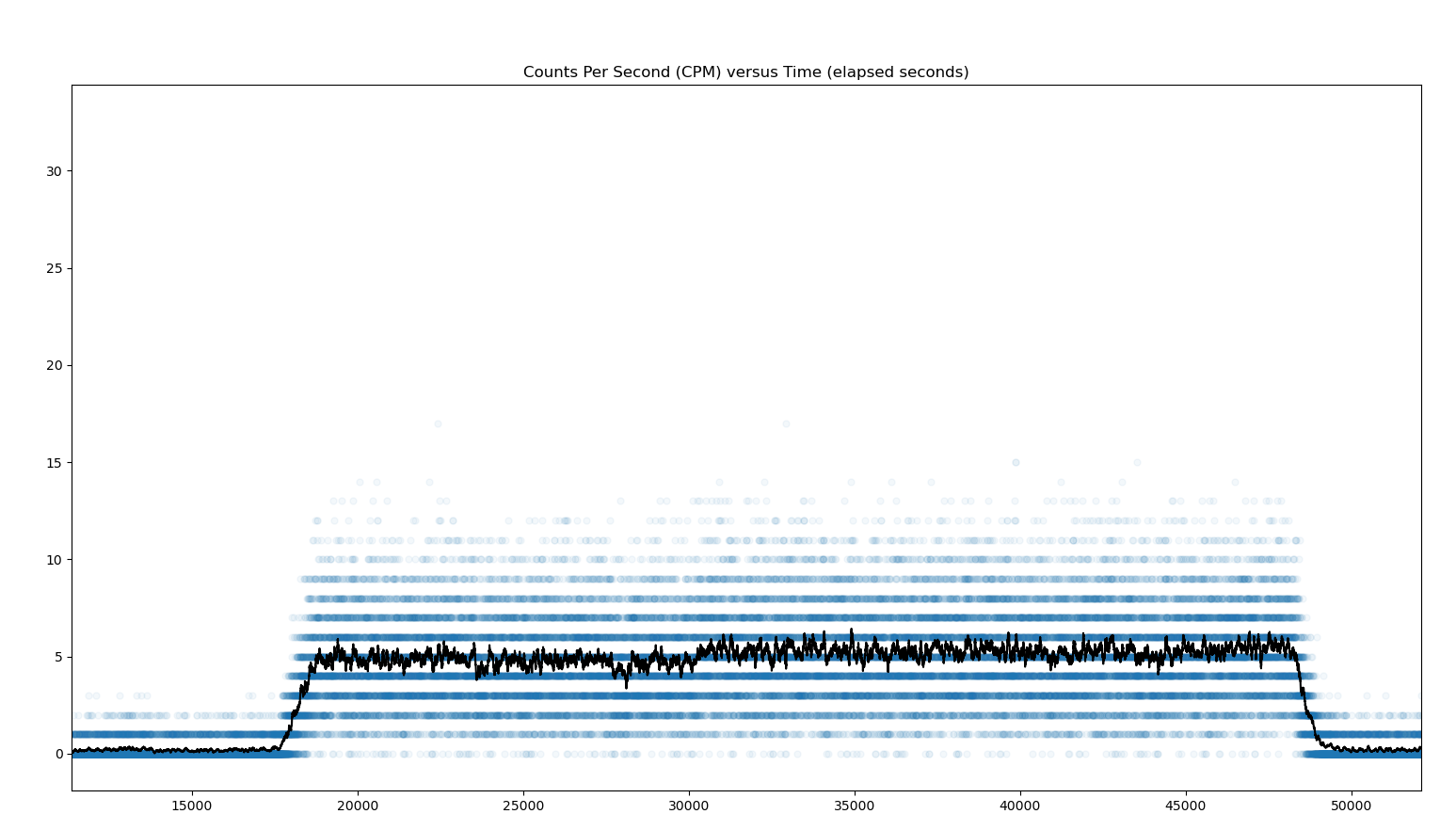
This flight was a couple days after the giant auroras of early 2024, and I was curious whether there might be corresponding spikes of activity picked up by the Geiger counter as we passed far north. But whether due to a lack of timely coronal mass ejections or my inability to detect them, I did not see any peaks in the data that couldn't be explained by altitude and noise alone.
Here's a plot of measured radiation over a pair of short flights.
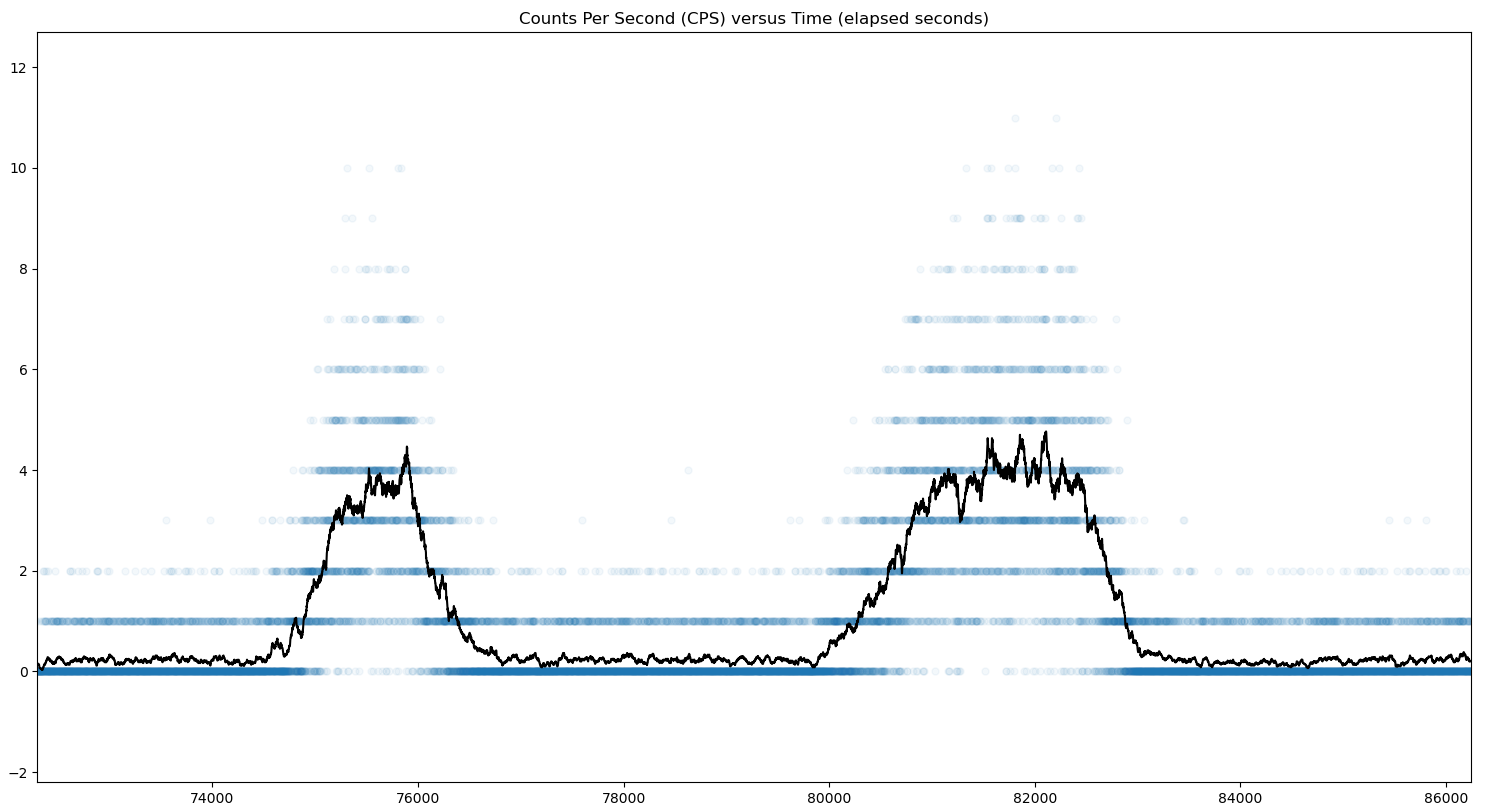
Counts per second plotted over a flight from Berlin to Munich and then to Dubrovnik.
This one subway station in Berlin
While traveling through Berlin, I spontaneously presented the above findings in a 5-minute lightning talk at Hack & Tell at c-base. Afterwards during the question period, somebody mentioned a radioactive subway station elsewhere in the city called Rosenthaler Platz. Of course, I visited at the first opportunity.
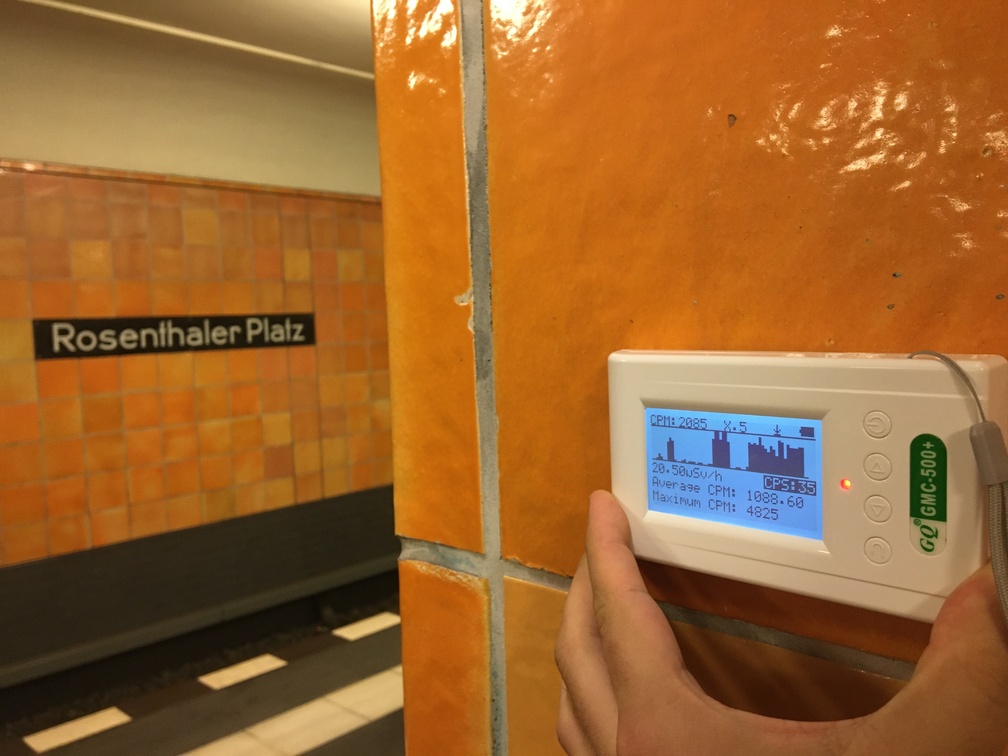
A radioactive ceramic tile on the wall of Rosenthaler Platz U-bahn station. I think I recognize this colour...
The whole subway station is covered in uranium-glazed tiles!!!
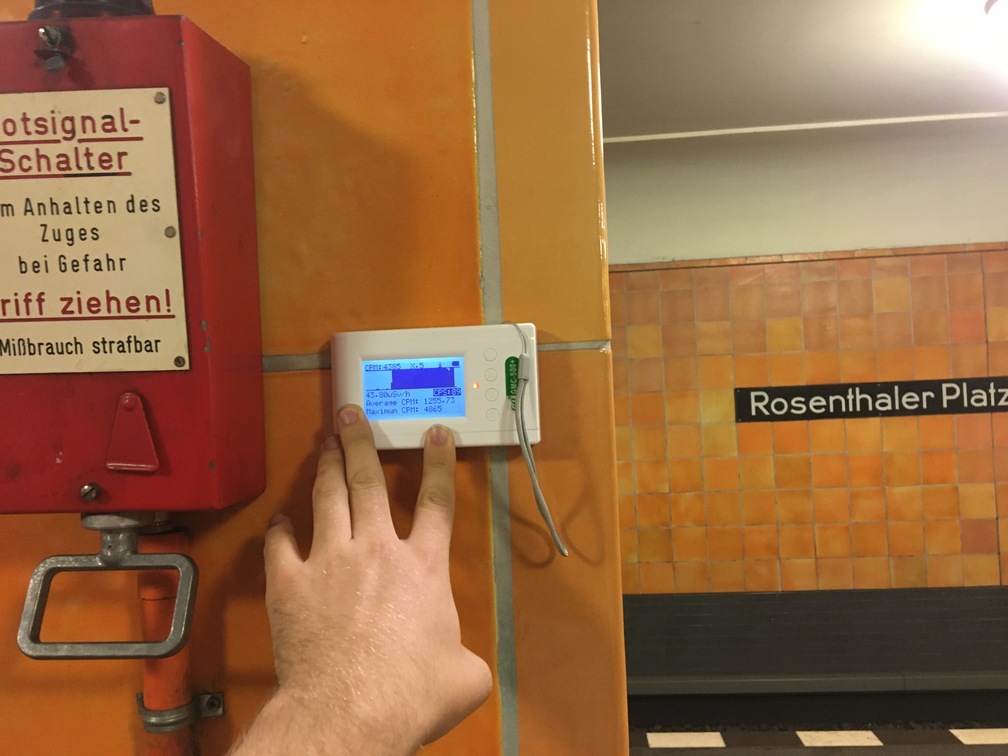
Mildly concerning.
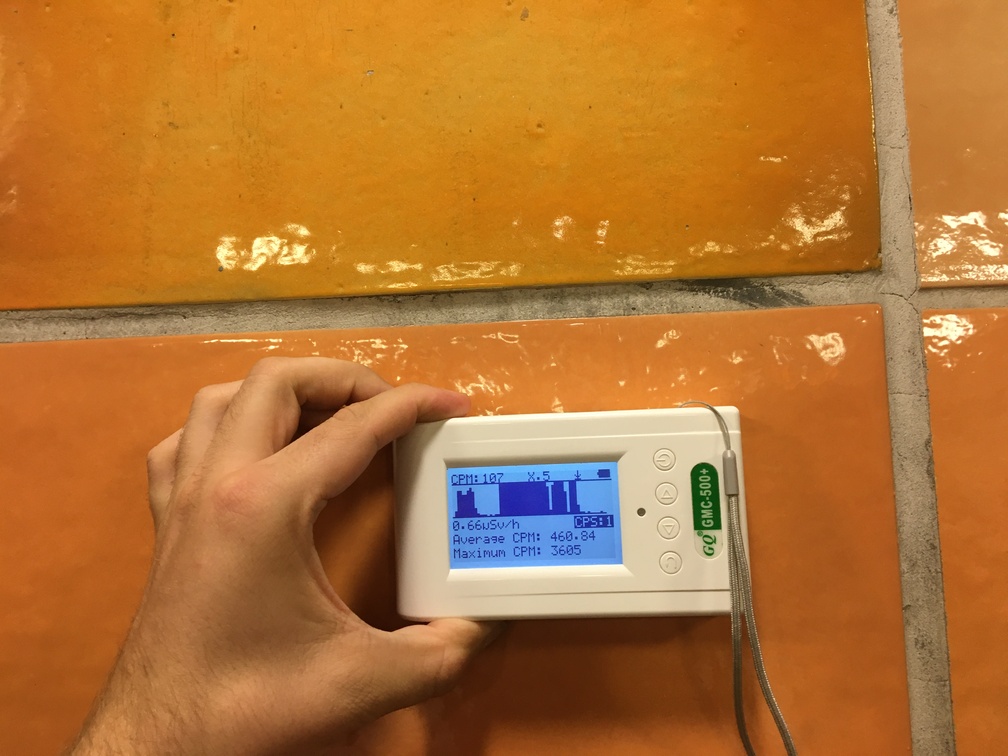
This off-colour tile is fine though.
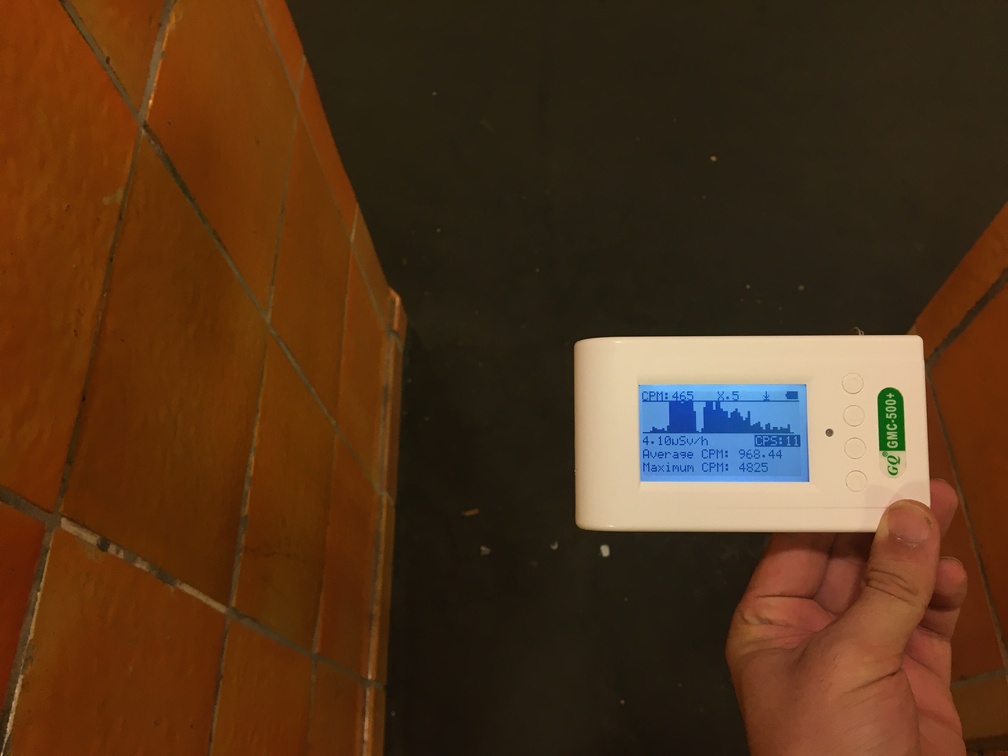
With this large of an area source, the falloff with distance is more gradual, resulting in measurable radiation levels many centimeters from the tiled columns.
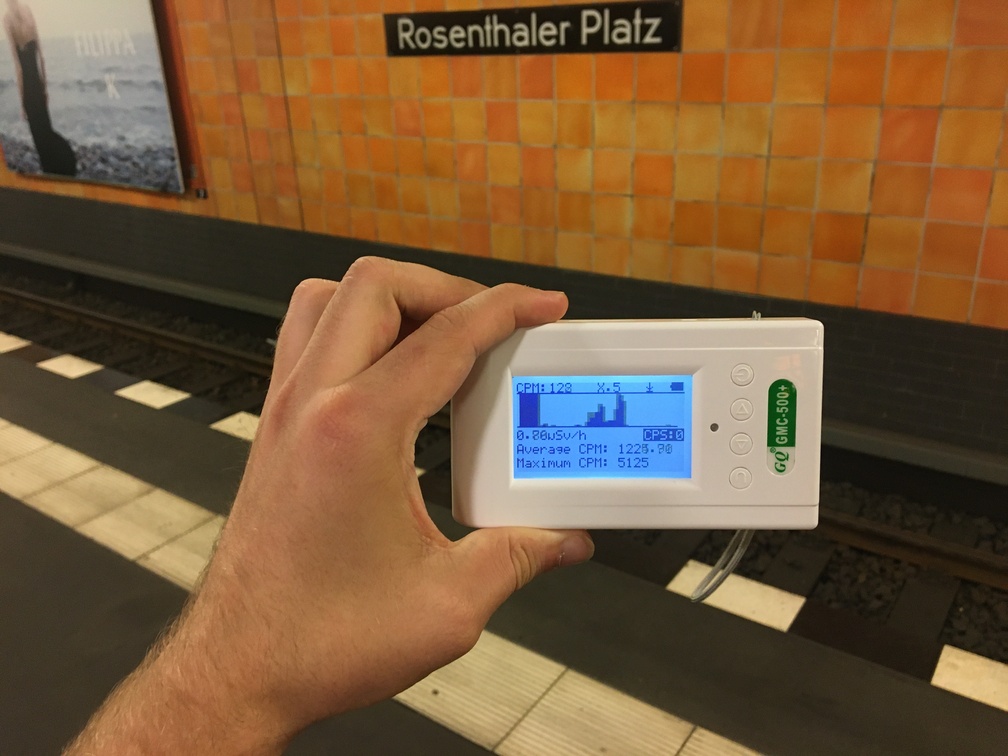
Further from the columns where people actually spend time waiting, the radiation is practically undetectable.
Rosenthaler Platz was opened in 1930, back when the original radioactive uranium-glazed Fiestaware was also being produced. While it's not a building choice that would be made today, the colour is indeed very nice. And although it's measurably radioactive, the levels aren't outright hazardous, and because nobody spends great lengths of time here or eats lots of food off of the ceramic glaze (I hope), the risk to humans is fairly low, and the station keeps its warm orange hue.
The city of Vancouver is not radioactive
The last finding I want to share is a negative one. At one point, I accidentally left the Geiger counter powered on inside my bicycle panier for a week while I cycled back and forth along my long commute between the suburbs and downtown Vancouver.
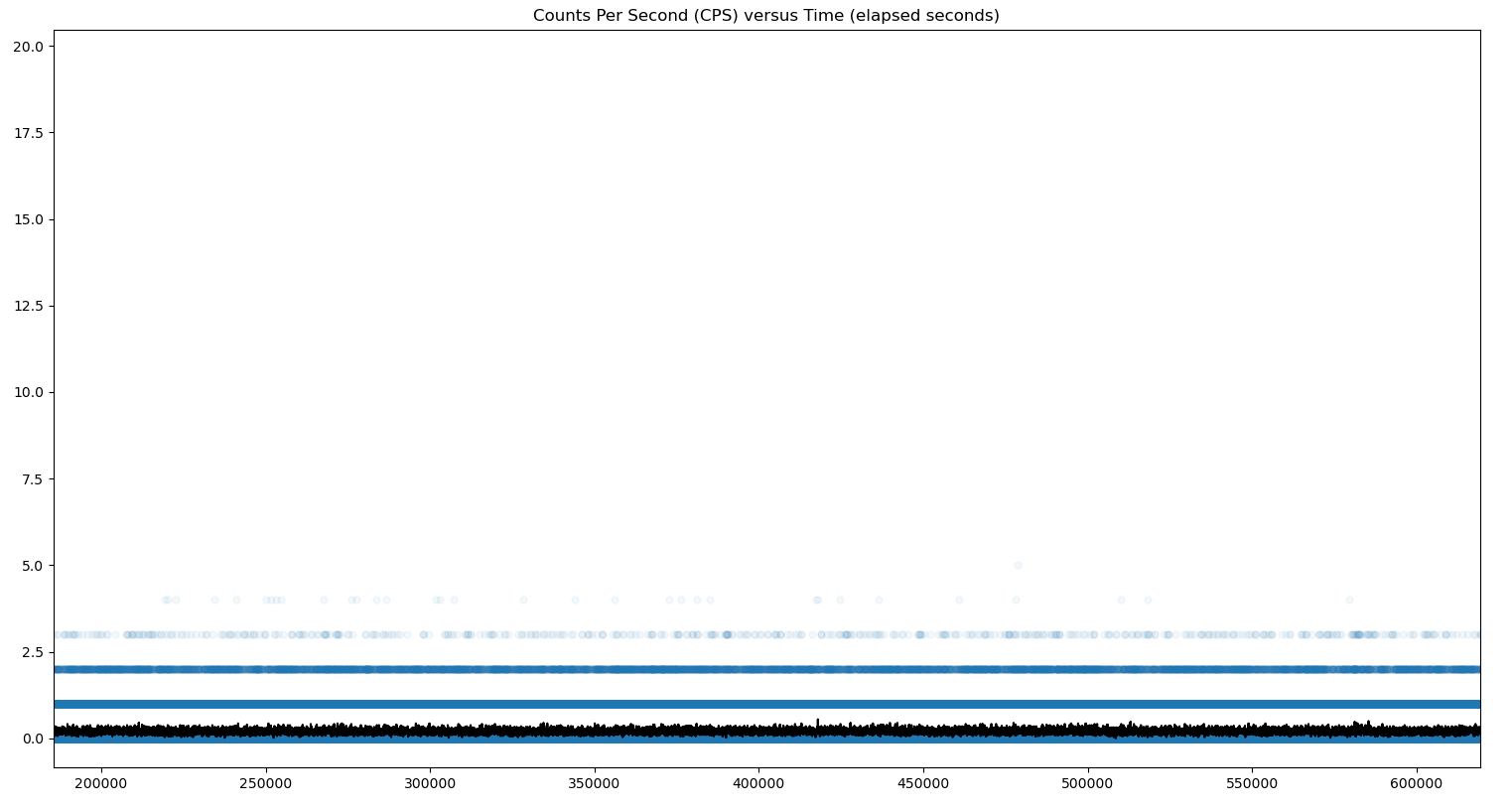
Counts per second over a week while travelling all over Vancouver.
As when I started with the Geiger counter, I found a whole lot of nothing.
I feel very safe here.
Subscribe to my RSS feed.
Send me comments and questions via email.